Department of Terrestrial Magnetism
Night TrainThe Department of Terrestrial Magnetism is the research unit at the Institute of Physical Problems where Jennifer Rockwell worked. Its routine depended on checking and reducing large volumes of astronomical data, while its researchers competed over fundamental questions about the universe. A week before Jennifer’s death, she altered values in a research program, destroying a month’s work and turning the department’s data procedures into part of the story of her final days.
Institution and Setting
The department is housed within the Institute of Physical Problems, north of CSU in the foothills of Mount Lee, near an old observatory. The institute’s low, wood-clad buildings are a marked contrast to the cosmic scale of the questions pursued inside them. At the entrance corridor, a biblical inscription invokes the knowledge of good and evil, placing the pursuit of knowledge in view before the department’s scientific work begins.
Organization and Research
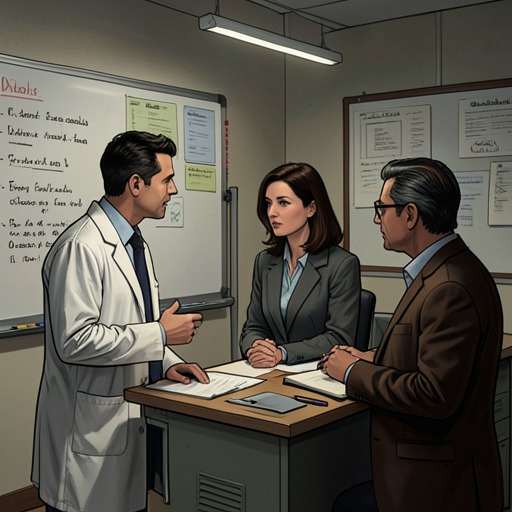
Department head Bax Denziger describes a three-tier working structure: staff in white coats operate the laboratories and computers; postdoctoral researchers and possibly assistant professors direct that work; and he, as department head, directs the organization as a whole. Each day, a large quantity of incoming data must be checked, processed, and reduced. Jennifer’s regular responsibility was that data-reduction work, alongside research of her own.
Her independent work included the Milky Way’s Virgo-infall velocity. The department also participated in research into the age and structure of the universe, a field Denziger characterizes as both controversial and cutthroat. Its questions included the rate of cosmic expansion, the rate at which that expansion was slowing, the universe’s total mass-density parameter, and whether the universe was open or closed. The work thus joined painstaking data processing to disputes with consequences for competing researchers and institutions.
Jennifer’s Work and the Altered Program
In the week before her death, Jennifer made what Denziger calls her first major job error. She had been assigned to defend distance measurements in M101 while the department was competing with Princeton. The work depended on plate-density scans containing millions of numbers, which were compared and calibrated by computer algorithms. Denziger first saw unusually strong reductions, then realized that Jennifer had changed the program’s values: the velocities and metallicities were false, and a month’s work had been lost.
Denziger did not regard the changes as an accidental mistake. He interpreted them as malicious, a judgment that makes the incident more than a technical failure: the department’s instruments and data could be deliberately turned against the research they were meant to support. The scale of the loss also gave the alteration an immediate institutional cost, arriving amid an already intense contest with Princeton.
Supervision and Significance
The incident exposes the personal pressure within the department’s hierarchy. When Miriam Rockwell told Denziger what had happened, his first response was relief that he would not have to kill Jennifer when she came in; he then felt profound guilt and wondered whether she had feared his anger. His account connects the department’s competitive expectations to his own responsibility as Jennifer’s supervisor, without establishing why she changed the program.
The department therefore matters both as Jennifer’s workplace and as the setting for an unresolved breach of scientific trust. Its ordinary processes—data arriving, being checked, reduced, and interpreted—make the alteration legible, while the competitive research culture gives the loss its stakes. Denziger’s later guilt shifts attention from the corrupted figures to the relationship between supervisor and researcher, but his account does not settle Jennifer’s motive.